People often ask, “if God is real, why doesn’t He just show Himself visibly to everyone”. One key reason is related to the preservation of the gift of free-will that God gave to each person. If God visibly revealed Himself to mankind it would hinder free-will decision-making; and this free-will decision-making is what each person uses to decide if they want to love, follow, and spend eternity with God; or go their own way. It could be comfortably argued that one of the motivations (of many) that God veils Himself with a shroud of “invisibility” is for love-based reasons.
Those who have come close to God throughout history have been overcome with tremendous fear, being completely and utterly overwhelmed by His indescribably awesome presence and His immeasurable power (Exo 20:19, Mat 17:5-7). The very nature of God makes it difficult for direct interactions to take place with humanity without embedding a significant fear-based bias that heavily influences mankind’s thought processes and decisions.
If God (in unveiled form) asked a person if they wanted to spend eternity with Him, it would be impossible to know what the person truly wanted since there would be an all-consuming fear associated with saying “no”. It would boil-down to choosing God for eternity out of fear (when they actually wanted something else), versus choosing God for eternity out of love.
For example, imagine there was a king that was in full control of a peasant woman’s life and livelihood. The king fell in love with the peasant woman and wanted to marry her. If he asked the woman to marry him, he would never know if her response of “yes” was because she loved him or because she feared the consequences of saying “no”.
The only way for him to obtain her love-based response would be to veil himself from her somehow, let her get to know him, and then ask from behind the veil. Perhaps he could “veil himself” by donning the clothes, appearance, and position of a peasant man and see if she fell in love with him; and then ask her to marry him. If she said “yes”, it was on the basis of love and she truly wanted to spend her life together with him. After he had her true answer, then he could reveal his position as king.
If God’s presence was visible, there would be no way for God to know if His free-will wielding child truly wanted to spend eternity with Him because they loved Him, or if they desired something else and didn’t want Him. Although God deeply loves all of His children, and wants to spend eternity with each of them, He will not force His children to be in His presence for eternity if they don’t want to be there…that’s not loving. For this reason, it makes sense that God would veil Himself with invisibility until folks freely choose Him of their own un-coerced volition.
As a side note, for those that choose to live eternally with God, He reveals Himself to them in many ways (sometimes visibly). One of the most tangible ways is through the Holy Spirit that He gives to indwell each person (Act 2:38). The Holy Spirit is the Spirit of God that He fuses into each person that chooses Him (Rom 5:5). The love-based relationship with God grows through-out their life on earth, and this loving relationship ultimately continues/transfers to eternity in Heaven when: 1) the person physically dies; 2) God pays their sin debt; and 3) they receive a new immortal incorruptible body that God has prepared for them so that they can live together for eternity in God’s perfect realm/presence (1Co 15:52-53).
Reference Scriptures:
Exo 20:19 Then they said to Moses, “You speak with us, and we will hear; but let not God speak with us, lest we die.”
Mat 17:5-7 – While he was still speaking, behold, a bright cloud overshadowed them; and suddenly a voice came out of the cloud, saying, “This is My beloved Son, in whom I am well pleased. Hear Him!” And when the disciples heard it, they fell on their faces and were greatly afraid. But Jesus came and touched them and said, “Arise, and do not be afraid.”
Act 2:38 Then Peter said to them, “Repent, and let every one of you be baptized in the name of Jesus Christ for the remission of sins; and you shall receive the gift of the Holy Spirit.
Rom 5:5 Now hope does not disappoint, because the love of God has been poured out in our hearts by the Holy Spirit who was given to us.
1Co 15:52 in a moment, in the twinkling of an eye, at the last trumpet. For the trumpet will sound, and the dead will be raised incorruptible, and we shall be changed.
1Co 15:53 For this corruptible must put on incorruption, and this mortal must put on immortality.
In an effort to remove suffering from humanity, the obvious questions arise:
1) “Could God give humanity free-will but prevent mankind’s select evil actions that cause suffering?”
2) “Since God is all powerful – Could God create an alternate reality in which free-will beings exist, and evil corruption does not, and simply morph humanity into this realm”
The answer to the first question is No. The answer to the second question is Yes and No. The following discussion provides insight into these non-intuitive responses.
Mankind was created in God’s image (Gen 1:26-27) and was bestowed the privilege of having free-will (Deu 30:19). This gift of free-will enables people to: 1) exhibit love; and 2) exist as unique autonomous individuals.
Without free-will, love cannot exist in humanity. Without choice, people would be “robots” repeating what they were programmed to say. Repeating “I love you” to God when no other option exists, is not love. Free-will provides God’s children with the opportunity to choose to have a loving relationship with Him if they want to.
Additionally, without free-will, the sentient self-aware “thought” that uniquely defines and animates each person would not exist. In essence, our minds are a continuous stream of free-will thought that fundamentally defines our unique “personhood”. We decide our next thought and weave our intricate mental thought-tapestry according to our desire/will/volition.
There are certainly natural bents and “mechanical” giftings that each person possesses (e.g., artistic or mathematical giftings) and these form the raw stock, or foundation, for each person’s free-will driven crafting of their own “personhood”. A person’s free-will directs and embeds mental pathways that define what they believe, what they call good and evil (morality), what they reject, what they say, what they do, plans, reasoning, direction, ambitions, dreams, perspectives, truth paradigms, politics, etc.
Consistent with the Bible, neuroscience research has discovered the our brains are “neuroplastic”. This means that our free-will thoughts functionally and structurally re-wire and change us both mentally and physically on an ongoing minute-by-minute basis so that we literally become the person we choose (Pro 23:7 “As a man thinks in his heart, so is he.“). Since no other human owns, or can control, an individual’s thoughts; in the context of humanity, each person is the sovereign ruler reigning supreme over their thought domain and the associated person it creates.
Since an individual’s unique personhood is literally a continuous direct product of their free-will thoughts; René Descartes famous quote, “I think, therefore I am”, becomes an elegant double entendre. Interestingly, this could also be re-phrased in reverse in an equally meaningful way, “if I can’t think, I am not”.
With the inseparable coupling between “free-will” and: 1) love; and 2) the existence of unique personhood, we’ll progress to discussing the rationale for the non-intuitive answers to questions 1 and 2. To assist with these discussions we’ll leverage the following definitions that establish a clear reasoning framework:
- We will define “evil” as any action that satan would promote and work toward. satan’s goals are to: 1) diminish/reduce/hinder “good” in any way possible; and 2) nucleate, amplify, implement, and expand malicious action.
- We will define “good” as everything that is of God as described in the Bible (The Father, Jesus, and the Holy Spirit).
- The “intent” of a person is not a measure of good or evil. The result of their action is the measure of good or evil (e.g., does suffering result from their actions). For example, deceit is an effective means to instigate evil via an unknowing good-hearted person.
- Additionally, a person’s ignorance does not excuse or justify the consequences of their action…either satan’s goals are advanced or they aren’t (evil happens or it doesn’t).
- “Action” is defined as an intentioned observable engagement with the physical world (physical/verbal/etc).
- Lastly, since the originating source of “action” is “thought”, the two terms are used somewhat interchangeably depending on context, with the clear understanding that there cannot be human “Action” without thought, but thought can exist without action.
We’ll address the first question first.
1) “Could God give humanity free-will but prevent mankind’s select evil actions that cause suffering?”
To achieve this end, every human thought would need to be perfectly policed though a filtering and rectifying “thought agent” that defined and issued what is perfectly good because this is the exact opposite of evil. Anything less than “perfect good” unduly results in a negative relative impact on humanity. Suffering from evil can take the form of direct malicious action (e.g., killing someone) or limiting/restricting a good action (e.g., restricting a gift of food to a starving family). Both are satan’s goals.
Only perfect good manages all forms of evil ideally. Any deviation from the “ideal” good leaves a remnant of un-necessary and preventable suffering.
This requires God to be a “thought agent” that filters every human thought, then rectifies and issues perfectly good thoughts in place of each person’s own thought. Consequently, the thoughts within the head of every person would ultimately need to be God’s thoughts because His thoughts are perfectly good (opposite of evil).
In essence, there is nothing better for the subject person AND all the adjacent lives that are directly or indirectly impacted by the immeasurably complex cascading ripple effects of that person’s decisions/actions on others (present and future…10s, 100s, 1000s of years of ripples from a decision).
Since thought would need to be issued from God, humanity would essentially parrot verbatim from God. If a person had a thought that was an “ideal” thought it would need to be the same thought as God would have, thus indistinguishable from God commanding the thoughts of the person. Or said another way, each person would no longer exist as they are, God would hear an 8 billion voice echo of Himself from earth in order for evil to be eradicated from its current embedment in humanity. Thus each person’s unique personhood would be gone.
A person could ask… Are there thoughts/actions that would not fall in the “good versus evil God governance bucket” so some free-will thought could still exist; meaning that some remnant fraction of a heritage individual’s identity could persist, e.g., which clothes I wear, type of car I drive, color of my house. There would likely be better or worse options for each, because the good versus evil measurement is not relative to the subject person (not egocentric), it is relative to society and the complex present and future impact of a person’s decisions. The cascading events resulting from a decision could directly or indirectly result in something evil now, or 50 years from now.
For example, the clothes you select may cause someone to have lustful thoughts that promote a poor action, the car you select may be a poor use of money (money that could have been partially allocated to stop 124 children from dying of starvation in the next week), the color of house paint you select could influence a future buyer to select a different house, a house that doesn’t allow them to meet the next-door neighbor that would have resulted in the collaborative formation of a global life-saving charity.
Since every decision a person makes whether “good/charitable” or “bad/evil” or “seemingly indifferent” has the potential to deliver a net negative impact to others through a mind-mesmerizing incomprehensible cascade of countless present and future possible events across all people and all time; then essentially all thoughts would ultimately need to be God’s perfect thoughts to ideally manage the “evil from humanity” that results in suffering.
Additionally, it should be understood that the definition of “best or ideal for humanity” also requires a capable arbiter (God) to define what best looks like for the aggregate sum of mankind over all time. For example, is the “ideal” spiritual prosperity, or satisfying basic physical needs, or material wealth, or entertainment, or leisure, or relationship prosperity, or salvation, or eternal prosperity, etc (with some of these competing…as one goes up, another may go down). For every thought in all humanity, in real-time, God would need to be doing what is “best” considering all the different ways “best” could be defined for every thought as it would impact everyone, everywhere, over all present and future time.
Pondering the above considerations, the existence of any remnant fraction of an individual’s heritage free-will crafted “personhood” would be contingent upon the existence of more than one thought at a decision-point that yields a perfectly net neutral impact on the current and future “good” of mankind. After that, a person would need to independently have one of those thoughts such that God could use their “free-will thought” and still achieve “ideal good”…or said another way, “no suffering from evil”. As highlighted earlier, the vastly complex nature of achieving “ideal good” suggests that the likelihood of this scenario is negligibly small.
Regardless, if God stopped all evil action through direct human thought intervention, each person would cease to exist as they are now. The only question is whether any residual remnant of a heritage person’s personhood could be forensically discoverable after God intervened in humanity to direct thought in each person’s mind across the planet to “ideally” remove “evil” from the world. In reality, if 80% of a person is gone, or 99.9% of a person is gone; the original person is gone, because 100% is what defines the identity of a person now.
There are many additional subtleties / nuances / questions that could be academically chased in this discussion, e.g., the uniqueness or non-uniqueness of a single “optimal/ideal good” solution. Why doesn’t God eliminate satan to manage/reduce evil? But you have the reasoning framework at this point to explore these scenarios and bring them to closure.
In summary, the answer is No, because the removal of all evil action that results in suffering would necessitate controlling all human thought to the degree that the unencumbered free-will that establishes the unique identity of each person on the planet would cease to exist – meaning God would need to press the “delete” button and end the existence of each person on the planet if He gave humanity what they were asking for (i.e., no suffering from evil).
Considering that suffering is intrinsically coupled to the irreconcilable complications associated humanity having free-will in a sin-laden environment, the second question naturally arises:
2) “Since God is all powerful – Could God create an alternate reality in which free-will beings exist, and evil corruption does not, and simply morph humanity into this realm”
The answer is Yes and No because there is a preordained ordered sequence of events for all mankind [birth → sentience → free-will decisions → death → free-will selected destination] that will deliver an answer of ‘Yes’ for some, and ‘No’ for others…depending on what each person wants.
The Bible highlights that the scenario outlined in question 2) is awaiting those that use their free-will to choose to submit themselves to the God of the universe and His ways, and choose to live eternally with Him. God provides the means for them to achieve this end, and provides a new immortal incorruptible body (1Co 15:52). Additionally, the Bible says that He will make a new heaven and new earth where their new incorruptible bodies will reside (Rev 21:1).
This begs the question, “Why didn’t God just do this in the first place for all mankind and avoid the suffering that humanity experiences now?”
The reason is that mankind had to be given free-will to choose if they wanted to love God and spend eternity with Him, before morphing them into His presence forever (potentially against their will).
In the historic past, mankind’s use of free-will created a path vectoring legal issue. The issue originated when mankind was tempted with the prospect that they “could become like God” if they acquired the “knowledge of good and evil” (Gen 3:5). The “die was cast” for mankind when both the “knowledge of good and evil” (Gen 2:17) and “evil-action” (aka sin) entered humanity through free-will decisions. This resulted in irreversible legal implications for all mankind (Rom 5:12).
God made immutable physical laws that govern our physical reality, e.g., Newton’s Law. Similarly, God also made immutable moral laws that are an inherent product of His perfect nature. Our modern-day civil laws distinguish and delineate ‘right’ from ‘wrong’, and establish legal accountability and law-breaking penalties for its resident populous.
In the same way, at a moral level for all humanity, the “knowledge of good and evil” imbues the same legal accountability to each person on earth (i.e., knowing ‘right’ and ‘wrong’). In essence, this knowledge of good and evil makes each person legally accountable for the free-will actions they select (good or evil) and also subjects them to the associated law-breaking penalties.
When God says something, it must happen exactly as He says, otherwise it makes God a liar. As such, when God says the penalty for breaking “this” law is “that”, the penalty must happen precisely (to the letter) as specified, or God is a liar (and that is impossible).
God wrote core moral tenants that transcend time, culture, and location on each person’s heart. The following scripture highlights this key reality:
- “For the wrath of God is revealed from heaven against all ungodliness and unrighteousness of men, who suppress the truth in unrighteousness, because what may be known of God is manifest in them, for God has shown it to them” (Rom 1:18-19)
For example, if I ask an innocent child, “is it good or bad to poke Billy in the eyes with a sharp stick and make him blind”, or “is it good or bad for Billy to take Suzy’s favorite toy and smash it”, or “is it good or bad for a Daddy to hit a Mommy and make her cry”. Regardless of where, or when, or to whom these questions are asked, the ingrained moral coding in the child will yield the same answers. This God-imputed “conscience” becomes the most base, and universal, form of moral “law” given to all mankind.
God created human thought. As such, He programmed morality into thought so it would be indelibly ingrained in every person such that it would be active in every moment and every situation of a person’s life.
- “…who show the work of the law written in their hearts, their conscience also bearing witness, and between themselves their thoughts accusing or else excusing ” (Romans 2:14-15)
This intrinsic knowledge that a person possesses regarding right and wrong, combined with free-will decisions to do what a person’s conscience tells them is wrong, creates the “law breaking legal issue” mentioned earlier. This is a legal issue that everyone faces personally (Jas 2:10).
As people mature through childhood they become fully sentient and fully aware of right and wrong (good and evil). At this point, they can use their free-will to choose to adopt corrupt self-serving egocentric definitions of good and evil, that will work against what has been written within them by God. satan plays a key role in enticing, tempting, and lying to each person such that they adopt corrupt “carnal” versions of morality that endorse whatever the person desires/craves. The Bible is clear that a person’s intentional free-will driven resolute march against God’s moral code written in their heart ultimately hardens their heart (Eph 4:18-19).
- “For since the creation of the world His invisible attributes are clearly seen, being understood by the things that are made, even His eternal power and Godhead, so that they are without excuse, because, although they knew God, they did not glorify Him as God, nor were thankful, but became futile in their thoughts, and their foolish hearts were darkened” (Rom 1:20-21)
If a person relentlessly pursues their version of morality by endlessly battling against God’s moral law speaking through their conscience (Rom 1:28-32), then God ultimately “gives them over” to the moral reality they crave, and their conscience becomes defiled/seared (Tit 1:15, 1Ti 4:2). After their conscience is seared/defiled, they wholeheartedly believe that their personal version of morality truly defines “good” and “evil”.
In essence, they have intentionally rejected the God of the universe and established themselves as the “god of their world” by ascribing to themselves the God-owned authority to define good and evil. This highlights the importance of God assessing whether a person wants “God’s ways”, or their own ways, BEFORE “morphing them into God’s realm”.
By the time a person is given over to their sin by God, they have endlessly, intentionally, and fervently fought against God’s morality implanted in their being. At that point they’ve clearly and repeatedly communicated to God via word and action that they don’t want Him or His ways. In essence, they don’t like Him, or want Him. If they were morphed into God’s heavenly realm, they would immediately use their free-will to gather like-minded persons and rebel against God and His ways (just like they did on earth).
Since God is holy and perfect, it is virtually impossible for imperfect lawbreakers to reside with Him unless the penalty for their lawbreaking is fully paid. Once payment is made, it removes the infraction from the person’s account and fully absolves them of the crime. With the exception of Jesus, the immutable moral law that has been broken by everyone on earth is the law of Sin and Death (Rom 8:2).
Since evil/sin is diametrically opposite, and immeasurably abominable relative to the holy perfect nature of God, the judgement for sin is death. Mankind cannot be with God in Heaven unless the legal debt of death is fully paid according to the law of Sin and Death. The legal issue that must be resolved by each person before they can be “morphed to the heavenly evil-free and suffering-free alternate reality with God”, is that they owe “death”.
God made a way to handle mankind’s death penalty. The solution is elegant in that it achieves multiple ends with one act. God’s solution:
- Identifies those that want Him, want His ways, revere Him, submit to His sole godhood, trust Him, and who want to spend eternity with Him (i.e., they wouldn’t seek His solution if they didn’t want to spend eternity with God, because that’s what the solution delivers)
- Fully absolves each person of the death they owe so they can gain access to God’s realm after their physical death; enabling them to live with God.
- It identifies those that do NOT want sin for rest of eternity (i.e., included in the ‘solution’ they request from God is a new incorruptible eternal body after they physically die).
- Prior to physical death, God’s solution fills those who want Him, with Himself (Holy Spirit) (Jhn 14:20, Rom 5:5). This enables the relationship that will last for eternity to be grown before physical death (even though God remains invisible to humanity for reasons discussed in the first section).
As you’ll recall, this was one of the primary reasons that free-will was given to mankind originally — so love could exist, and so people could freely choose to love God and live with Him forever; or choose to go their own way.
The solution God crafted was for Him to pay the death penalty on behalf of His children so the requirements of the law of sin and death could be fully satisfied. Since the crime was committed by humans, in the human reality, under the legal jurisdiction and laws that apply to humanity; God put on the human flesh He created, lived a sin-free life on the planet He created, permitted Himself to suffer tremendously and be crucified, raised Himself, and returned back to Heaven.
“…He forgave us all our sins, having canceled the charge of our legal indebtedness, which stood against us and condemned us; he has taken it away, nailing it to the cross.” (Col 2:13-14)
Since God is sin-less, the death He paid does not have an associated death-debt obligation that He owes; consequently, God used it to pay the death debt for mankind’s sin. God took upon Himself all the sin of all humanity (1Jo 2:2) — all aggregate sin of the past, present, and every possible sin scenario that free-will choices could create in the future.
The payment of death was put in-place for each person individually, in all of humanity, in one single act of love for each of His children. The Bible says that God desires that “All men [humanity] to be saved” (1Ti 2:4). This means that God’s death penalty payment is available to each person for the death they owe at judgement — if they want to accept it. Herein lies the greatest question each person faces, a question that they ultimately answer throughout their life…”Do you want to accept Jesus’ death in payment for your death-penalty to enable you to live with the God of the Universe for eternity“.
By analogy, assume a person gets a speeding ticket and is fined $50. Either the person can pay the $50 themselves or someone else can pay it (e.g., their Dad). Once paid, the court is fully satisfied (i.e., the requirements of the Law are satisfied), and the person is free to go. Payment can happen in anyway, as long as $50 is delivered to the court. This is where free-will enters the scenario.
The law-breaker stands before the judge at sentencing. When the judgement of $50 is levied, the person can use their free-will to:
- Choose to pay the court themselves, or
- Ask their Dad to pay the court, or
- Try to walk out of the courtroom saying, “I don’t believe in speed limits, so I haven’t committed a crime”, or “the speed limit is lower than what I believe it should be, as such, I haven’t committed a crime according to laws I have created for myself”.
The judge will respond, what you personally believe about the law is irrelevant, you owe $50.
When God says the judgement for an act of moral imperfection (sin) is death, death must be paid. There is no other option. When God asks each person if they sinned (broke His moral law), every person’s answer will be ‘yes’ (Rom 3:23). With an ocean of love in the Judge’s eyes, the perfect Judge’s gavel must fall for each person with the precise judgement of death being assigned (Rom 8:2, Rom 6:23). God took off His heavenly Judges robe, put on flesh, and then paid the debt of death for each of His children (1Jo 2:2) with His own blood. This creates the means for His child to freely choose Him and live with Him for eternity if they want to by accepting the death payment; conversely His child can refuse and choose to travel a path away from God.
For those that are more graphically minded, the following flowchart illustrates the sequencing, and event progression in support of both questions 1 and 2. In the illustration below, time progresses from historicity on the left to an individual’s life progression and ultimate eternal endpoint on the right.
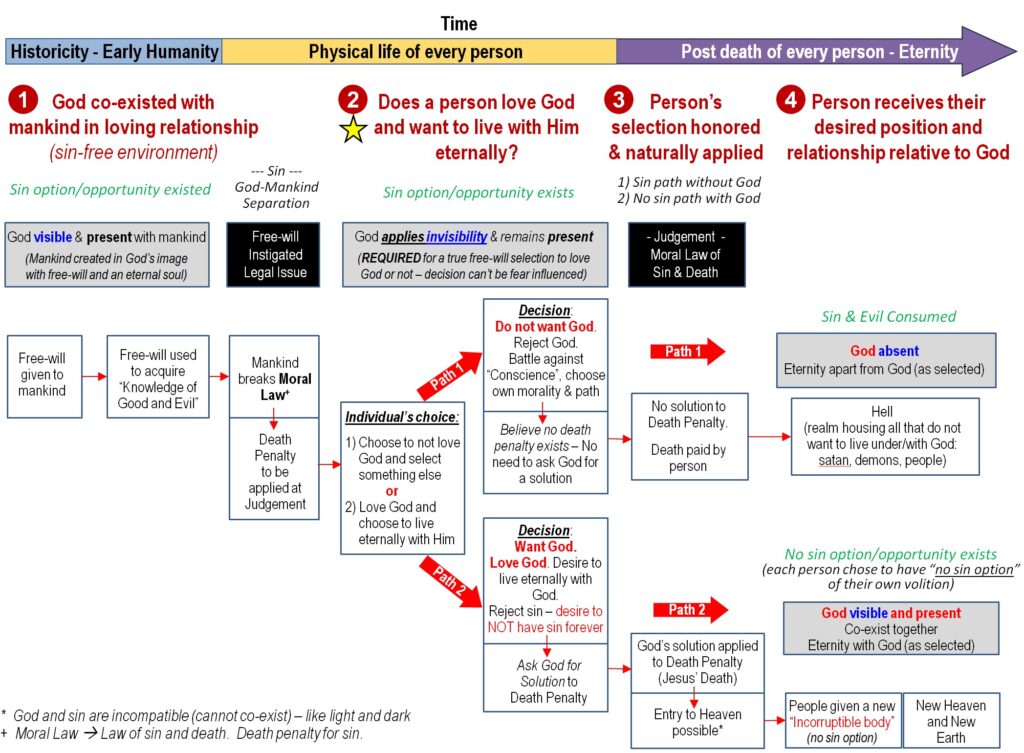
If we translate the courtroom trial for breaking the speed-limit law, to the courtroom trial for breaking the law of Sin-and-Death, the analogous verbal exchange with the Judge would be:
1) A person can say to the Judge (God),
It is important to understand that “Belief” is key to accepting the “death payment”. The death payment “oral contract” between a person and God can only take place if the two parties engage with each other to establish the legal agreement on the specific topic.
If a person doesn’t believe that God exists (i.e., the other party), or that a debt of death exists (i.e., the contract topic), then there is no oral contract possible. This is why belief is critical (Jhn 3:16).
2) Or a person may also say,
- “I have done many good things in my life that compensate for the sin that I’ve done, so I deserved to go to heaven”
- “I deserve to go to the good place I have envisioned after death because I have met the entry expectations that I’ve established for myself.”
- “I have rejected the God of the Bible’s morality, I don’t agree with it, and I don’t want any part of it.”
- “I have my own morality, and I have built my own doctrine I believe regarding life after death.”
- “I have elected to not believe in God, nor life after death, as such, I don’t believe there is sin or an associated death-penalty. Consequently, I am not accountable to any higher power and fully rule my domain”
God may say, you are not on trial for the good that you have done, you are on trial for the sin you have committed that has broken the Law, and what you personally believe about the law is not relevant.
God may also say, I’ve engaged you many times (Jhn 12:32) (listing all the times and ways God connected with them from childhood through to their last breath…Holy Spirit, visions, dreams, conversations, conscience, writings, etc) and you have rejected Me, mocked Me, ignored Me, and have despised My ways and who I Am. You have set your heart and mind against me throughout your life. Your sin is incompatible with Me and Heaven. The godhood that you have ascribed to yourself is also incompatible with My Kingdom. The true desire of your heart that you’ve exemplified throughout your life is not found with Me or in Heaven.
A person’s free-will choice regarding God naturally/automatically selects the future path for them. If a person creates and chooses their own morality (moral law) that is complicit with their lifestyle and their self-engineered beliefs, then, in their minds they don’t have a “legal issue” to resolve with God (Psa 10:4). As such, they have no need for the biblical God of the universe, nor do they have a need to seek Him for a solution to the “legal issue”.
Obviously their personal belief-system construct does not protect them from the consequences of breaking the Law of Sin and Death any more than not believing in Newton’s Law (gravity) will stop a person from falling to their death if they run off a high cliff yelling “gravity is a myth”. The law is the law.
Their life-story evidences their lack of interest in submitting themselves to God and His ways, as well as their lack of desire to have a relationship with Him (let alone having a loving eternal relationship). Their life-story of thoughts and actions firmly establishes and exemplifies their true “heart’s desire” and its associated “free-will choice”.
This is “THE” fundamental life-vectoring choice each person has:
- Do they want to be the god of their world, or
- Do they want to submit themselves to the God of the universe and ask Him be the ruler of their world and live in a loving relationship with Him for eternity
A person must have free-will to decide to follow the God of the universe, or to follow their personal “god-hood” path. God will not force someone into a realm that they abjectly disagree with, and to be subject to an authority that they’ve intentionally renounced, and to be around Him for eternity if they don’t like Him or His moral laws.
In summary, the answer to the question “Could God create an alternate reality in which some sort of free-will beings exist, and evil corruption does not…and just morph humanity into this realm” is ‘Yes’ for those that choose to have the God of the universe as their god because He has made provision for it to happen (i.e., paid the death penalty, and provides an incorruptible new body) and He has the power to make it happen. The answer is ‘No’ for those that choose be their own god, and reject the God of the universe despite His pursuit of them throughout their lives.
RECONCILING SCENARIOS 1) AND 2)
Reconciling understandings developed from scenarios 1) and 2) is important since it may appear that they deliver conflicting results.
Scenario 1) reasoned that if God removed evil, then mankind would cease to exist via God’s required control of essentially every thought of every person, i.e., the removal of mankind’s free-will that can produce evil, also removes the same free-will that defines each person’s unique personhood. Yet scenario 2) argues that mankind can live with free-will and no sin/evil.
Is there a conflict? The answer is No. The difference between the two is related to state. Additionally, the two states must be ordered so that 1) precedes 2).
In scenario 1) evil exists and is present with mankind, and within mankind. In State 1, a person can freely choose to select evil or good at any time. While mankind can choose to do great good, mankind also carries sinful bents that can lead to horrific evil (envy, bitterness, hatred, unforgiveness, jealousy, lust, greed, violence, arrogance, murder, genocide, etc).
For those that choose the path to God in scenario 2), the end-state of each person and the environment is very different. In choosing the path to God, during each person’s progression through State 1, they use their free-will to elect to have an incorruptible body for eternity. In essence, they chose to not have the ability to choose to sin, and they chose to reside in Heaven, which is a sin-free environment (per God’s perfect and Holy nature). As such, there is no reason for God to intervene and own every thought as in scenario 1). All thought and action is good in State 2 (i.e., not sinful). Additionally, the unique “personhood” of each individual is NOT lost in State 2, it is upgraded from State 1 in alignment with the individual’s free-will desire (it is not imposed by God on a person).
In essence, the Biblical character goals that folks were working toward over their lives are granted by God in the twinkling of an eye (i.e., desires to be loving, unselfish, generous, patient, kind, faithful, etc) and likewise that bad characteristics they were striving to shed over their lives are removed by God in an instant according to the person’s desire (hate, jealousy, greed, unforgiveness, envy, lust, violence, etc).
Through God’s action, they’ve instantly arrived at the “person” that their free-will driven “personhood crafting” efforts were striving to achieve over their lives. The transformed individual would say, “this is finally ‘me’, the person I’ve be striving to be. Everything that I’ve hated in my character is finally gone (the evil nature that was driving me to do, and crave, what I didn’t want, and I knew was bad) and the good that I’ve longed to expand, and add, is full and complete.”
This allows God to receive into Heaven those that:
- Want to be there
- Want to have a loving relationship with Him for eternity
- Want to submit themselves to His authority and ways, and
- Choose to have the “ability and desire to sin” removed from their nature
In scenario 1) God would need to forcibly control all humanity through each person’s thought to battle against a world that is infused with evil, occupied by evil, and inhabited with people having the freedom to select evil at will. In essence, a realm of evil chaos in which people have evil bents and the desire and ability to follow them. The state requires God to have complete thought overwrite/control for each person to remove evil from a world occupied and saturated by evil.
In scenario 2) the end-state environment is heaven, where no evil chaos exists, and the people used their free-will to have their ability to choose evil removed by God (i.e., incorruptible bodies).
As such, there is nothing in state 2) that would require God to intervene and implement thought control. Everyone resides in a perfectly good realm (no evil exists), and everyone has an incorruptible body that reflects the Godly character “person-hood” that they were craving throughout their earthly lives (loving, unselfish, generous, patient, kind, faithful, humble, sinless, etc).
Obviously, before a person can choose to “leave behind” evil, they must have the choice to choose good or evil; which means the state/environment in scenario 1) must precede the state environment in 2). Or said another way, 2) is possible only after the free-will choices that only reside in 1) are exercised (i.e., an environment that permits good versus evil choice).
Before physical death, mankind resides in scenario 1) where the option for evil action MUST exist in order for humanity to exist. After death, God has paved the path (with His own blood) for mankind to come to Him, if they want to, with their personhood preserved and enriched with the Godly character that they desired in Scenario 1) and live in His sin-free world with Him eternally.
Biblical References:
Deu 30:19 – “I call heaven and earth as witnesses today against you, that I have set before you life and death, blessing and cursing; therefore choose life, that both you and your descendants may live;
Gen 1:26-27 – Then God said, “Let Us make man in Our image, according to Our likeness; … So God created man in His own image; in the image of God He created him; male and female He created them.
Pro 23:7 – “As a man thinks in his heart, so is he.”
Jas 2:10 – For whoever shall keep the whole law, and yet stumble in one point, he is guilty of all.
Jhn 3:16 – For God so loved the world that He gave His only begotten Son, that whoever believes in Him should not perish but have everlasting life.
Heb 2:9 – But we see Jesus, who was made a little lower than the angels, for the suffering of death crowned with glory and honor, that He, by the grace of God, might taste death for everyone.
Col 2:13-14 – “…He forgave us all our sins, having canceled the charge of our legal indebtedness, which stood against us and condemned us; he has taken it away, nailing it to the cross.”
1Jo 2:2 – And He Himself is the propitiation for our sins, and not for ours only but also for the whole world.
1Ti 2:4 – who desires all men to be saved and to come to the knowledge of the truth.
Rom 6:23 – For the wages of sin is death, but the gift of God is eternal life in Christ Jesus our Lord.
Rom 3:23 – for all have sinned and fall short of the glory of God,
Rom 8:2 – For the law of the Spirit of life in Christ Jesus has made me free from the law of sin and death
Eph 2:8 – For by grace you have been saved through faith, and that not of yourselves; it is the gift of God,
Jhn 12:32 – “And I, if I am lifted up from the earth, will draw all peoples to Myself.”
Rom 10:9 – that if you confess with your mouth the Lord Jesus and believe in your heart that God has raised Him from the dead, you will be saved.
Rom 10:13 – For “whoever calls on the name of the LORD shall be saved.”
Act 2:21 – And it shall come to pass That whoever calls on the name of the LORD Shall be saved.
Isa 59:2 – “But your iniquities have separated you from your God; And your sins have hidden His face from you…”
Exo 20:19 – Then they said to Moses, “You speak with us, and we will hear; but let not God speak with us, lest we die.”
Jhn 14:20 – “At that day you will know that I am in My Father, and you in Me, and I in you.
Jhn 16:7 – “Nevertheless I tell you the truth. It is to your advantage that I go away; for if I do not go away, the Helper will not come to you; but if I depart, I will send Him to you.
Act 2:38 – Then Peter said to them, “Repent, and let every one of you be baptized in the name of Jesus Christ for the remission of sins; and you shall receive the gift of the Holy Spirit.
Rom 5:5 – Now hope does not disappoint, because the love of God has been poured out in our hearts by the Holy Spirit who was given to us.
Eph 1:13 – In Him you also trusted, after you heard the word of truth, the gospel of your salvation; in whom also, having believed, you were sealed with the Holy Spirit of promise,
1Co 15:52 – in a moment, in the twinkling of an eye, at the last trumpet. For the trumpet will sound, and the dead will be raised incorruptible, and we shall be changed.
1Co 15:53 – For this corruptible must put on incorruption, and this mortal must put on immortality.
Rom 1:28-32 – And even as they did not like to retain God in their knowledge, God gave them over to a debased mind, to do those things which are not fitting; being filled with all unrighteousness, sexual immorality, wickedness, covetousness, maliciousness; full of envy, murder, strife, deceit, evil-mindedness; they are whisperers, backbiters, haters of God, violent, proud, boasters, inventors of evil things, disobedient to parents, undiscerning, untrustworthy, unloving, unforgiving, unmerciful; who, knowing the righteous judgment of God, that those who practice such things are deserving of death, not only do the same but also approve of those who practice them.
Rom 1:18-19 – For the wrath of God is revealed from heaven against all ungodliness and unrighteousness of men, who suppress the truth in unrighteousness, because what may be known of God is manifest in them, for God has shown it to them.
Rom 1:20-21 – For since the creation of the world His invisible attributes are clearly seen, being understood by the things that are made, even His eternal power and Godhead, so that they are without excuse, because, although they knew God, they did not glorify Him as God, nor were thankful, but became futile in their thoughts, and their foolish hearts were darkened.
Mankind’s earthly blessings can be curses, and their earthly curses can be blessings.
God deeply cares about the eternal destination of His children. He demonstrated this by electing to don the human flesh He created, and allowing Himself to be slaughtered by the children He loves, so that He could pay the penalty of death that each person owes for breaking the law of Sin-and-Death. It is undeniable that God loves His children to a degree that humanity cannot comprehend. He knows that all that really matters is an individual’s eternal residence after their infinitesimal moment on earth expires.
The Bible is clear that one of the reasons God allows trials in a person’s life is to transition them from God-defying arrogant self-deifying individuals (Psa 10:4), to broken humble people willing to call-out for help, thus enabling them to have the opportunity to choose to be eternally saved by God, or not.
The historic account of King Nebuchadnezzar provides a good example of this “humbling” principle (Dan 4:30-37). Nebuchadnezzar had grown his kingdom to the point that he was one of the most powerful men in the world. His immense prosperity led him to believe that he was in charge of everything. In his arrogance he didn’t even realize that his “next breath” was not guaranteed, and each moment of life was a gift from God.
At the pinnacle of Nebuchadnezzar’s self-exaltation and arrogance – The king spoke, saying, “Is not this great Babylon, that I have built for a royal dwelling by my mighty power and for the honor of my majesty?” (Dan 4:30). As soon as he said this God took away his rational mind. This resulted in Nebuchadnezzar being driven from men and living like an animal for a set period of time designated by God. After the time elapsed, Nebuchadnezzar lifted his eyes to heaven and God returned his senses to him (Dan 4:34).
Realizing what had transpired, and appreciating that God returned his rational mind to him, King Nebuchadnezzar praised God for His power and greatness…”Now I, Nebuchadnezzar, praise and extol and honor the King of heaven, all of whose works are truth, and His ways justice. And those who walk in pride He is able to put down.” (Dan 4:37). God, in His mercy and grace, fully gave Nebuchadnezzar his throne and kingdom back.
Everyone that saw Nebuchadnezzar would have thought that a “horrible thing” happened to him…he lost everything. However, God had different plans. This “horrible thing” was actually a path to potential eternal salvation for Nebuchadnezzar. With his pride gone, and a correct understanding of God’s nature established, this gave Nebuchadnezzar the opportunity to choose whether he wanted to submit to God and live with Him for eternity, or go his own way. Without the “horrible event”, Nebuchadnezzar wouldn’t have received the blessing that was intrinsically coupled to the terrible event; as you can see, they come as an inseparable fused pair (trials and blessing).
Could there have been another way for God to make this happen? We’ll never know. However, what we do know is that God knows each of His children better than they know themselves, He knows the best way to “engage” them given their “hardwiring/personality/bents”, He loves them beyond measure, He is all knowing, all powerful, and omnipresent; as such, we can safely assume that God’s plan is the ideal tailored plan for each child per their individual “personhood” as well as their current and future decision-option domain, and subsequent repercussions on all people that the event(s) would directly or indirectly effect for all time.
This is the issue – When people think they are in control of everything, and their world is prospering, they can easily come to the conclusion that they don’t need God (Rev 3:17). God knows their eternal destination without Him; as such, in an effort to draw His Children to Himself so that they can choose to be saved, He permits difficulty, trial, pain, and unfairness because without it, much greater pain could result.
The Bible says that pride is one of the 7 things that God “hates” (Proverbs 6:16-19). It is understandable why God hates pride, it naturally drives His beloved children away from Him and it ultimately leads to immeasurable pain and destruction.
Historically, the combination of pride and free-will have caused incomprehensible carnage to life. The most consequential examples being:
- The fall of satan and 1/3 of the angels
- The fall of humanity
Remarkably, and importantly, both of these pride-instigated cataclysmic “falls” occurred in a perfect sin-free environment; one in Heaven, the other on earth.
When unencumbered free-will exists, pride can be adopted, when pride is adopted, self-important self-exalting posturing relative to God is fostered and fueled. These are the ingredients, and the environment, that ultimately lead to rebellion against God with its associated irreversible destruction because the sin-laden rebels must be eternally removed from God’s perfect sin-less presence (Pro 16:18).
This is why is it important for each person that chooses to live with God for eternity to receive both a new “incorruptible” body, and a death-payment “salvation ticket” to Heaven. Without a new incorruptible body, the same free-will instigated fall that happened in the original perfect sin-free environment of Eden could repeat itself; and since God said we would be with Him eternally (Rom 6:23, Jhn 10:28-29), that would make God a liar (which is not possible). Each person is fundamentally asking God to apply “limitations” to their free-will in Heaven so that they cannot be corrupted at any time in the infinite future (even in the perfect sin-free environment of Heaven). The “incorruptible” body God gives them reflects their free-will request, i.e., nothing is being forced on them by God that is outside of their unencumbered free-will desire / choice / request.
Cancer, divorce, paralysis, blindness, etc that are the inherent products of living in an imperfect corrupted world, may ultimately bring eternal salvation through the humility, vulnerability, and desperate need for God that overwhelming hardship and suffering creates. Without them, a person may arrogantly march through life straight into eternal damnation. God will not let this happen unless it is what they choose of their own free-will since God desires that ALL of His children live with Him for eternity (1Ti 2:3-4). A person needs to be given the opportunity to know Him, before they can choose if they want Him, or not. Choosing to reach out to God wouldn’t happen for many people with “pride and prosperity” shackles binding them to their earthly worldview, and blinding them to God (Psa 10:4).
God is perfectly loving. As such, He will not force a person to spend eternity with Him if they don’t want Him (Rev 3:20). That would not be loving. Ultimately, people need to decide if they want God to be in charge of their lives, or if they want to be the god of their lives.
The seemingly “horrible things” that happen will be deemed the greatest blessing imaginable by those eternally saved through them. In the future, trillions of years from now when they are in Heaven with God, they will look back and say, “that nanosecond of time on earth that I experienced great pain and suffering was the most valuable moment in my eternal life, and in comparison to the infinite blessing and joy I have experienced as a result of it, the ‘pain-of-the-time’ is vanishingly non-existent” (1Co 2:9).
The difficulties, pain, and trials experienced by each person over the course of their lives could be thought of as an aggregate “pain minimization” plus “blessing and opportunity maximization” endeavor that is applied with an eternal timeframe lens for each of God’s children that honors both the free-will of the person and God’s desire for each of His children to choose to live with Him forever.
References
Proverbs 6:16-19 – “There are six things that the LORD hates, seven that are detestable to Him: haughty eyes, a lying tongue, hands that shed innocent blood, a heart that devises wicked schemes, feet that run swiftly to evil, a false witness who gives false testimony, and one who stirs up discord among brothers.”
1Ti 2:3-4 – For this is good and acceptable in the sight of God our Savior, who desires all men to be saved and to come to the knowledge of the truth.
1Co 2:9 But as it is written: “Eye has not seen, nor ear heard, Nor have entered into the heart of man
The things which God has prepared for those who love Him.”
Rev 3:17 – “Because you say, ‘I am rich, have become wealthy, and have need of nothing’—and do not know that you are wretched, miserable, poor, blind, and naked—
Rev 3:20 – “Behold, I stand at the door and knock. If anyone hears My voice and opens the door, I will come in to him and dine with him, and he with Me.
Pro 16:18 – Pride goes before destruction, And a haughty spirit before a fall.
Psa 10:4 – The wicked in his proud countenance does not seek God; God is in none of his thoughts.
Col 1:16 – For by Him all things were created that are in heaven and that are on earth, visible and invisible, whether thrones or dominions or principalities or powers. All things were created through Him and for Him.
Rom 6:23 – For the wages of sin is death, but the gift of God is eternal life in Christ Jesus our Lord.
Jhn 10:28-29 – And I give them eternal life, and they shall never perish; neither shall anyone snatch them out of My hand. My Father, who has given them to Me, is greater than all; and no one is able to snatch them out of My Father’s hand.
In addition to the indispensable eternity-vectoring post-death benefit of human suffering there are also important pre-death benefits. While it is certainly paradoxical in nature, a large degree of suffering can deliver a commensurately large opportunity for joy, peace, and fulfillment that would not be readily attainable without suffering. The paradox is best understood in the context of couple key human realities.
First, there is an innate desire ingrained in the psyche of humanity that seeks to operate independently of God and His ways (Rev 3:20, Rom 8:7). It is a consequence of residing in a sin-laden world where pride in skills and achievements establishes a person’s self-worth, and praise from others anchors a person’s value. As such, it is human nature for mankind to seek to independently handle their life journey using their mental capacity, reasoning, skills, resources, and abilities.
Second, humanity was designed and created to be with God. This is the natural “complete” state for each person. The separation of mankind from God via sin (Isa 59:2) resulted in a “void” within the inner-being of each person. This ‘void’ can only be filled by God. Due to mankind’s independent, sinful, and rebellious nature (Ecc 7:29, Jer 17:9), people through the generations have been endlessly searching to fill the inner void with anything, or anybody, that offers hope.
With this backdrop, the paradox is more easily understood. The Bible says that when we are weak He is strong – ”… for My strength is made perfect in weakness.” (2Co 12:9). Obviously God’s strength is not imperfect, that would be impossible. What the scripture is saying is that God’s strength in, and through, a person is made perfect through human weakness. The verbiage, “is made” highlights that God’s strength in a person is constructed, and this construction is progressive in nature to the point of “perfection” based on the degree of an individual’s weakness, i.e., the greater the weakness, the greater God’s strength (2Co 12:10).
The question then arises, “who does the construction?” Although arguable, there is a reasonable basis to arrive at the viewpoint that the degree of suffering in a person’s life journey combined with their free-will response to these challenges plays a key role in God’s power being made perfect in their weakness.
If a person’s life journey is relatively smooth (i.e., suffering and trial free), they may only have a small portion of their life that they deem “outside of their control”, thus requiring them to inquire of God for help. This means only a small portion of their life reaps the benefits of God’s omnipotence, omniscience, and omnipresence, because the person never felt they needed to engage God. Additionally, the life-path typically pursued by mankind when they walk independently of God targets satiating their core need, which is filling the “void”. However, without God, this is an exercise in futility that can never deliver the joy, peace, purpose, and fulfillment they crave.
The person ultimately navigates through life using the extraordinarily limited intelligence of a human, accessing and processing a minute amount of all possible information (past, present, future, physical, mental, emotional, spiritual, individual, community), using the miniscule power of a human, to travel paths to futile destinations. Would God have done something different to maximize the joy, peace, purpose, and fulfillment of this suffering-free and trial-free “blessed individual” if He was asked to guide/direct/lead/solve/help/etc? Undoubtedly “Yes” (Isa 55:8-9).
Is it possible to be “blessed” with minimal trials and suffering and still make righteous God-centric decisions that enable a person to have joy, peace, fulfillment, and purpose? In theory “Yes”, but in practice typically not. This is because the Bible is clear that a person that walks a righteous life closely with God will experience assorted trials for reasons that will become evident (Psa 34:19, 1Th 3:3-4).
Contrary to the “suffering free” individual, a person that experiences great trials and suffering in their life is prompted to call-out to God endlessly to interact and intervene in their life circumstances so that they can make it through. The greater the difficulty, challenge, pain, and suffering the person experiences the greater the fervor, passion, humility, and intensity in their cries to God for Him to deliver them through their trials. In return for their humble impassioned cries to God, they receive the trial-paid privilege of:
- Watching God do the “impossible” in their lives
- Receiving God devised, orchestrated, and implemented life-direction
- Experiencing His presence
- Building deep life-changing faith and trust in God based-on direct firsthand observation/experience, and
- Growing an interactive loved-based relationship with the God of the universe
The degree of challenge or suffering provides the proportional amount of fuel, impetus, and driving energy to motivate a person to open the door to God in their lives and pursue Him (where the door was formerly held closed by pride).
In essence, the person’s “weakness” that seemingly renders solutions to life-challenges unattainable, or impossible, paves the way for the unleashing of God’s eagerly “awaiting” power as they humbly ask/invite God into their realm of suffering and challenge. The continuous “merge” of God into the “every day” activity of the person’s life enables them to regularly see and experience His power, faithfulness, love, grace, mercy, justice, kindness, gentleness, forgiveness, wisdom, intelligence, and attentiveness. These tangible learnings become fused into the backbone of their daily existence, life reality, belief systems, perspectives, truths, life management practices, “personhood”, and worldview.
Because God is the definition of love, their interactive relationship not only connects them to power beyond imagination, it also imbues love and peace into them that transcends situations and environment (Phl 4:6-7). Through their path of suffering, they come to know their loving Father deeply by watching God do the incredible for them. As a direct result, they are able to weather tumultuous storms with confidence in their God’s demonstrated love, power, protection, and faithful provision.
This relationship allows them to walk a path through life that is willingly and intentionally guided and directed by their loving God. With God directing their lives, He leads them to peace, purpose, and joy that are independent of circumstances (Phl 4:11-13). A path that not only blesses them, but likely blesses others, and provides “void-filling” fulfillment that only God can deliver.
All of this is dependent upon how a person chooses to respond to pain, trials, and suffering in their lives. If a person chooses to ask God to help, the answer is always ‘Yes’ (Psa 34:19, Jas 4:8) because His love for us is beyond our ability to comprehend (Jhn 3:16-17). Note: Sometimes He responds in ways we don’t initially understand, but His ways are always the best possible path (Isa 55:8-9).
However, if a person chooses to stand steadfast in their pride in the midst of trial and suffering, then they have no relief or hope. As such, they typically chase means of temporary escape through drugs, alcohol, sex, hedonism, etc. Their “elixir” for escape from their suffering only causes greater destruction, which only increases their ravenous pursuit and consumption of their “elixir” that increasingly destroys them.
This self-reinforcing downward spiral results in people hitting “rock bottom”. Many times this brings a person to the point that they are willing to reach out to God, and ask Him to fix the chaos they’ve created in their lives through their independent decision-making, self-direction, and many times, God-defying self-governance. When they do, God works powerfully through their “complete weakness” as they release everything in their lives to Him and willingly relinquish control. Their humble and contrite free-will request to God to save them facilitates their loving God stepping into their life to renew, reconstruct, heal, redirect, and bless their broken lives (Isa 57:15, Rev 3:20).
God honors the free-will He gave mankind by allowing each person to decide how they want to run their lives. This includes the decision to include Him, or not. The pride-fueled natural bent of humanity predisposes them to “call the shots” in their lives and not include the God of the Bible in their life-journey. However, the suffering-crafted contrite person that humbly follows God is able to open the pride-locked door that liberates/activates/avails/instigates/motivates/fuels the release of God’s power and presence in their lives ”… for My strength is made perfect in weakness.” (2Co 12:9). This enables access to an individually-tailored God-crafted “void filling” life that is ultimately blessed in a fashion that is unattainable by a person living a suffering-free and trial free life (Isa 66:2). Mankind’s earthly blessings can be curses (Luk 18:24-25), and their earthly curses can be blessings.
References:
2Co 12:9 – And He said to me, “My grace is sufficient for you, for My strength is made perfect in weakness.” Therefore most gladly I will rather boast in my infirmities, that the power of Christ may rest upon me.
2Co 12:10 – Therefore I take pleasure in infirmities, in reproaches, in needs, in persecutions, in distresses, for Christ’s sake. For when I am weak, then I am strong.
Phl 4:11-13 – Not that I speak in regard to need, for I have learned in whatever state I am, to be content: I know how to be abased, and I know how to abound. Everywhere and in all things I have learned both to be full and to be hungry, both to abound and to suffer need. I can do all things through Christ who strengthens me.
Isa 55:8-9 – “For My thoughts are not your thoughts, Nor are your ways My ways,” says the LORD. “For as the heavens are higher than the earth, So are My ways higher than your ways, And My thoughts than your thoughts.
Psa 119:71-72 – It is good for me that I have been afflicted, That I may learn Your statutes. The law of Your mouth is better to me Than thousands of coins of gold and silver.
Psa 119:67-68 – Before I was afflicted I went astray, But now I keep Your word. You are good, and do good; Teach me Your statutes.
1Ti 6:9 – But those who desire to be rich fall into temptation and a snare, and into many foolish and harmful lusts which drown men in destruction and perdition.
1Ti 6:10 – For the love of money is a root of all kinds of evil, for which some have strayed from the faith in their greediness, and pierced themselves through with many sorrows.
Luk 18:24-25 – …“How hard it is for those who have riches to enter the kingdom of God! “For it is easier for a camel to go through the eye of a needle than for a rich man to enter the kingdom of God.”
Ecc 7:29 – Truly, this only I have found: That God made man upright, But they have sought out many schemes.”
Rev 3:20 – “Behold, I stand at the door and knock. If anyone hears My voice and opens the door, I will come in to him and dine with him, and he with Me.
Rom 8:7 – The mind governed by the flesh is hostile to God; it does not submit to God’s law, nor can it do so.
Isa 59:2 – “But your iniquities have separated you from your God; And your sins have hidden His face from you…”
Psa 34:19 – Many are the afflictions of the righteous, But the LORD delivers him out of them all.
1Pe 5:10 – But may the God of all grace, who called us to His eternal glory by Christ Jesus, after you have suffered a while, perfect, establish, strengthen, and settle you.
1Th 3:3-4 – that no one should be shaken by these afflictions; for you yourselves know that we are appointed to this. For, in fact, we told you before when we were with you that we would suffer tribulation, just as it happened, and you know.
Act 20:23 – …the Holy Spirit testifies in every city, saying that chains and tribulations await me.
Jhn 3:16-17 – “For God so loved the world that He gave His only begotten Son, that whoever believes in Him should not perish but have everlasting life. “For God did not send His Son into the world to condemn the world, but that the world through Him might be saved.
Phl 4:6-7 – Be anxious for nothing, but in everything by prayer and supplication, with thanksgiving, let your requests be made known to God; and the peace of God, which surpasses all understanding, will guard your hearts and minds through Christ Jesus.
Isa 57:15 – For thus says the High and Lofty One Who inhabits eternity, whose name is Holy:
“I dwell in the high and holy place, With him who has a contrite and humble spirit, To revive the spirit of the humble, And to revive the heart of the contrite ones.
Isa 66:2 – Has not my hand made all these things, and so they came into being?” declares the LORD. “These are the ones I look on with favor: those who are humble and contrite in spirit, and who tremble at my word.
Mic 6:8 – He has shown you, O mortal, what is good. And what does the LORD require of you? To act justly and to love mercy and to walk humbly with your God.
Isa 57:21 – “There is no peace,” Says my God, “for the wicked.”
Jer 17:9 – “The heart is deceitful above all things, And desperately wicked; Who can know it?
Jhn 12:26 – “If anyone serves Me, let him follow Me; and where I am, there My servant will be also. If anyone serves Me, him My Father will honor.
Jas 4:8 – Come near to God and He will come near to you.